When people think about aviation careers, passenger services and cabin crew are often the first areas that come to mind. However, air cargo is another major part of the aviation industry.
Aircraft transport documents, commercial goods, perishables, special cargo and other shipments across national and international destinations. Behind these movements are cargo agents, warehouse teams, freight forwarders, airline cargo departments and airport operations professionals.
Students interested in logistics and aviation can therefore consider an Air Cargo Operations course.
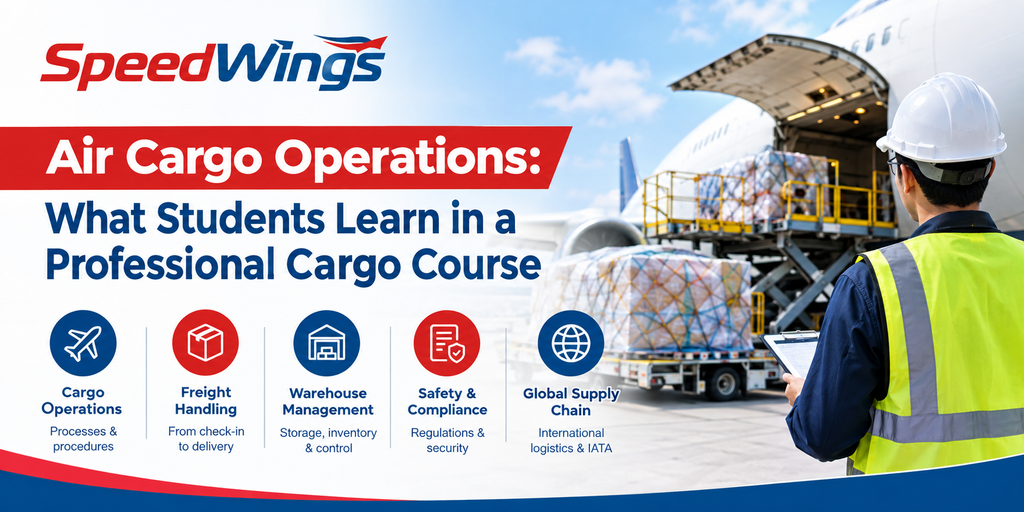
What Is Air Cargo Operations?
Air cargo operations involve the acceptance, documentation, handling, storage and transportation of goods by air.
The process may involve:
1. Customer booking
2. Cargo acceptance
3. Documentation
4. Security checks
5. Storage
6. Build-up
7. Aircraft loading
8. Transportation
9. Arrival handling
10. Delivery
Each stage needs accuracy and coordination.
Why Is Cargo Training Important?
Air cargo is highly regulated.
Different commodities may have different handling requirements. Dangerous goods, live animals, perishables and valuable cargo may require specialized procedures.
Professionals need to understand applicable rules and operational processes.
Cargo Acceptance
Cargo acceptance is an important first stage.
Staff need to verify documentation and ensure that shipments meet applicable requirements.
Incorrect information can create delays or operational problems.
Import and Export Procedures
International cargo involves import and export requirements.
Students should develop awareness of:
Shipping documentation
Customs procedures
Cargo declarations
Air waybills
Import requirements
Export requirements
Transit procedures
The exact requirements depend on the shipment, route and applicable regulations.
Air Waybill
The Air Waybill, commonly known as AWB, is a key document in air cargo.
Understanding its purpose and the information associated with it is important for cargo professionals.
Students should learn how documentation connects with the physical movement of cargo.
Cargo Rates
Cargo professionals may also need to understand how rates are calculated.
Rates can vary depending on factors such as weight, volume, commodity, route and applicable rules.
Professional training can help students develop a foundation in cargo rate calculations.
Special Cargo
Not all cargo can be treated in the same way.
Examples include:
Perishable goods
Live animals
Dangerous goods
Valuable cargo
Temperature-sensitive shipments
Special handling cargo
Each category can have specific requirements.
Unit Load Devices
ULDs are used to organize and secure cargo for aircraft transportation.
Students interested in cargo should understand the basic principles of ULD handling and aircraft limitations.
Aircraft Limitations
Cargo cannot simply be loaded into an aircraft without considering operational limitations.
Weight, dimensions, loading position and aircraft configuration all matter.
This is why cargo professionals need both documentation knowledge and operational awareness.
Career Opportunities
Cargo training can open pathways into areas such as:
Cargo agent
Cargo operations executive
Warehouse operations
Freight forwarding
Airline cargo
Airport cargo
Export/import documentation
Cargo customer service
Students can also develop careers in logistics and supply-chain organizations.
What Should Students Look for in a Course?
When comparing cargo programs, students should consider whether the curriculum covers:
Cargo acceptance
Air waybills
Import/export
Cargo rates
Special cargo
Dangerous goods
ULDs
Aircraft limitations
Cargo documentation
Practical exercises
Speedwings describes its Diploma in Cargo Operations Management as a six-month program for Plus Two and above, covering cargo acceptance, import/export rules, reservations, cargo rates, air waybills, special cargo and ULDs. (Phase2)
Practical Learning
Cargo operations are process-oriented.
Students can benefit from case studies and practical examples involving different types of cargo.
The ability to identify documentation errors, understand cargo categories and follow handling procedures can be valuable.
Conclusion
Air cargo is an important part of modern aviation and international trade.
Students who enjoy logistics, documentation, operations and international business may find cargo management an interesting career direction.
Instead of focusing only on passenger-facing aviation roles, students can explore the large number of opportunities available behind the scenes.
A Diploma in Cargo Operations Management can provide foundational knowledge for those interested in airport cargo, airline cargo, freight forwarding and related logistics careers.